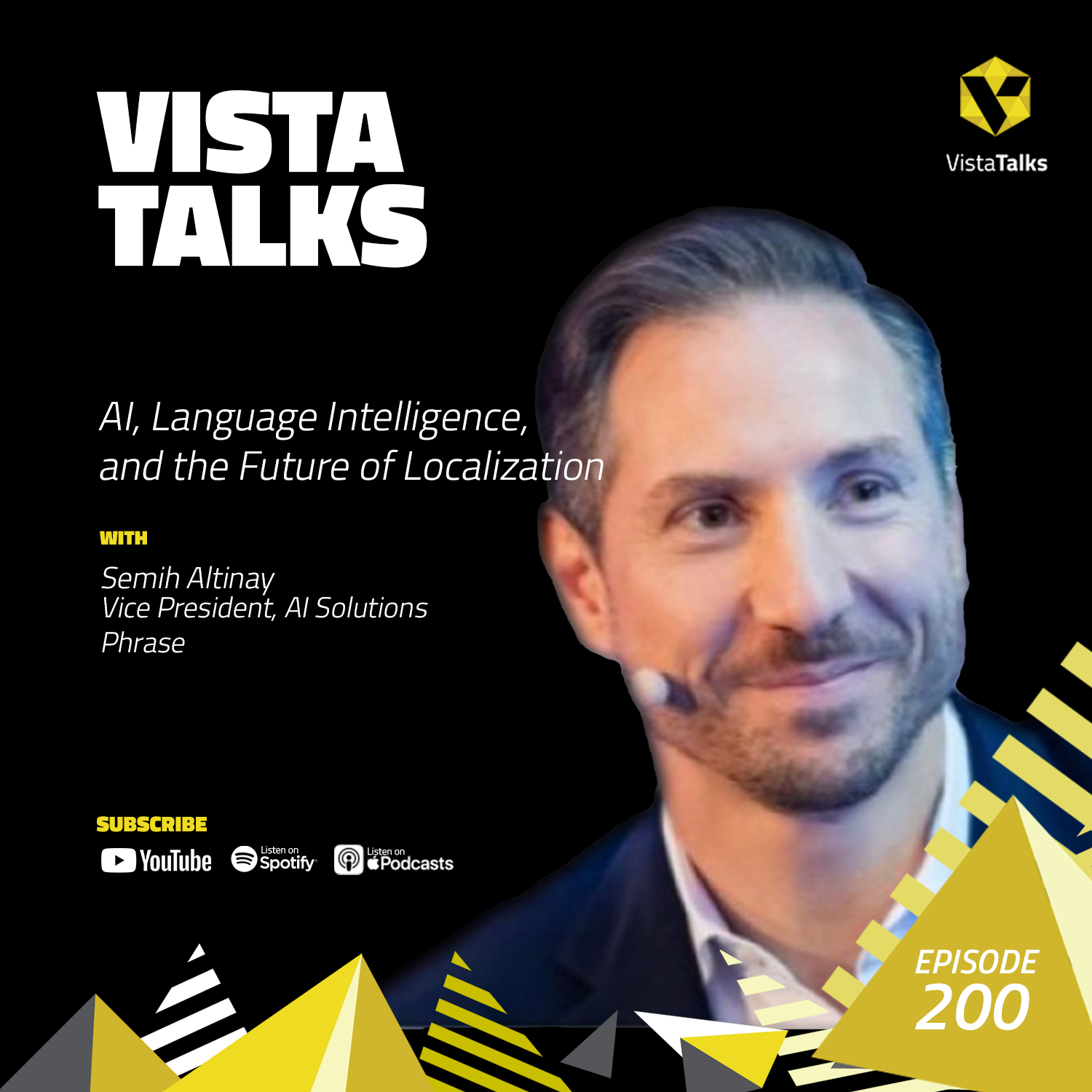
AI, Language Intelligence, and the Future of Localization with Semih Altinay – VistaTalks Ep 200
Keywords: Language Intelligence, Phrase, Semih Altinay, Localization, Simon Hodgkins, AI, VistaTalks, Artificial Intelligence
Run Time: 37:52
Release Date: July 22, 2026
Listen to the audio or watch the video below.
Semih Altinay, Vice President of AI Solutions at Phrase, joins VistaTalks Host Simon Hodgkins for a thought-provoking discussion on the future of AI, localization, and multilingual content. As artificial intelligence reshapes how organizations communicate across global markets, Semih explores why translation alone is no longer enough, why cultural intelligence matters more than ever, and how AI agents are redefining enterprise workflows.
The conversation moves well beyond technology. It explores the evolving role of human expertise, the growing importance of business outcomes over language outputs, and why localization professionals have an opportunity to become strategic contributors rather than operational support teams.
Artificial intelligence has been part of the localization industry for decades through machine translation and neural translation models. However, according to Semih, today's AI revolution is fundamentally different.
Rather than simply translating words from one language to another, modern AI systems are becoming capable of understanding intent, context, tone, and audience expectations.
As Semih explains, the conversation is shifting from translation accuracy to what he describes as "intent proximity", how closely AI can deliver content that reflects the original purpose and resonates naturally with the target audience.
This evolution has been driven by advances that simply did not exist a few years ago. AI models can now work with style guides, terminology databases, brand guidelines, quality evaluation models, and contextual information to produce significantly better multilingual content.
The result is an entirely new language intelligence lifecycle where translation becomes just one component of a much broader communication strategy.
AI Is an Enabler, Not a Replacement
One of the strongest themes throughout the discussion is the evolving relationship between AI and human expertise.
While many headlines continue to focus on automation replacing jobs, Semih takes a more balanced view. AI excels at removing repetitive, high-volume, low-risk work, allowing professionals to spend more time on activities that genuinely require human judgment.
Rather than replacing translators, reviewers, and localization specialists, AI is changing what their work looks like. Instead of manually translating every sentence, language professionals increasingly focus on defining quality, providing context, reviewing high-value content, and ensuring communications achieve the desired business outcomes.
The challenge facing organizations today is managing an explosion of content across websites, applications, videos, social media, user-generated content, marketing campaigns, documentation, and countless other digital channels.
AI makes this scale manageable, but people remain responsible for ensuring quality, creativity, and trust.
The Rise of Agentic AI
Another major focus of the conversation is the emergence of agentic AI.
Unlike traditional AI tools that complete individual tasks, AI agents can execute entire workflows with minimal human intervention. Semih believes this represents one of the biggest changes currently taking place across enterprise technology.
Rather than automating isolated translation tasks, organizations are beginning to automate complete multilingual content operations. AI agents can organize workflows, coordinate between departments, monitor quality, and escalate issues only when human intervention is required.
Marketing, HR, product teams, legal departments, and localization specialists can all work within connected systems rather than isolated silos. However, Semih is equally clear that autonomy requires responsibility.
Organizations must establish governance, quality standards, observability, and clear guardrails before trusting AI with critical business processes. The most successful implementations begin with low-risk content, measure outcomes carefully, and gradually expand automation as confidence grows.
Why Translation Alone Doesn't Create Business Value
One of the most memorable moments in the discussion comes when Semih challenges a long-standing assumption within the localization industry.
“No one really buys translation." Instead, organizations buy outcomes.
Customers want faster market entry, increased revenue, stronger customer engagement, improved product adoption, regulatory compliance, and memorable customer experiences. Translation is simply the mechanism that helps achieve those objectives.
This distinction fundamentally changes how localization should be positioned inside modern businesses. Rather than measuring success through words translated or cost per word, localization teams should connect their work directly to customer satisfaction, market growth, and business performance.
It is a shift from viewing localization as an operational cost center to recognizing it as a strategic business capability.
Cultural Intelligence Creates Competitive Advantage
AI has become remarkably good at producing fluent translations. But fluency alone does not guarantee success. Semih argues that organizations should think beyond linguistic accuracy and focus instead on cultural relevance.
A marketing campaign that performs exceptionally well in one country may fail completely in another, even if every sentence has been translated perfectly. Consumer motivations differ. Buying behaviors differ. Cultural expectations differ.
AI can now help organizations scale multilingual content production, but understanding what resonates emotionally with different audiences remains a uniquely valuable human capability. As AI becomes increasingly effective at handling volume, cultural judgment becomes even more important. The organizations that succeed globally will be those capable of combining automation with genuine local market understanding.
Localization Must Speak the Language of Business
Throughout the conversation, Semih returns to one important idea. Localization leaders need to change the conversations they have inside their organizations. Executives are rarely interested in translation volumes or language quality metrics. They care about revenue growth, customer satisfaction, market expansion, retention, and business performance.
Localization teams therefore need to align their work directly with corporate objectives and key results rather than operational metrics. By understanding broader business priorities first and then demonstrating how multilingual content contributes to those goals, localization professionals become strategic partners instead of service providers.
Semih even suggests looking at public company financial reports to understand where international revenue growth is occurring and using those insights to frame localization discussions in commercial rather than linguistic terms. It represents a significant mindset shift for an industry that has historically focused on operational excellence.
Managing Content at Unprecedented Scale
The explosion of AI-generated content presents organizations with new challenges.
Every business now produces vastly more content than ever before.
Marketing campaigns
Knowledge bases
Product documentation
Video
Audio
Support articles
Social media
Internal communications
The question is no longer whether organizations can create content. It is how they manage quality, consistency, compliance, and cultural relevance across hundreds of markets and multiple content types.
Semih recommends categorizing content according to risk. Not every asset requires the same level of human review. Marketing content may benefit from creative flexibility. Medical instructions demand strict compliance. Legal documentation requires specialist oversight.
By applying different governance models to different content categories, organizations can achieve both speed and confidence without compromising quality.
From Workflows to Conversations
Perhaps the most fascinating insight comes when discussing the future of localization platforms. Rather than building increasingly complex workflow systems, Semih envisions a future where users simply describe what they want. A marketer might explain the campaign objective, audience, markets, budget, compliance requirements, and brand guidelines. The AI platform would then automatically select the appropriate models, terminology, workflows, translation memories, style guides, quality checks, and human approvals.
The technology becomes invisible. The focus shifts entirely to business intent.
Instead of configuring workflows manually, organizations will increasingly communicate objectives while AI orchestrates the execution behind the scenes.
It is a vision where technology disappears into the background and business outcomes become the primary interface.
Final Thoughts
Semih Altinay offers a refreshingly practical perspective on artificial intelligence. Rather than presenting AI as either a miracle solution or an existential threat, he frames it as an extraordinary productivity platform that expands what organizations can achieve.
The future of multilingual communication will not be defined by replacing people. It will be defined by enabling people to focus on creativity, judgment, strategy, and cultural understanding while AI manages the complexity, scale, and automation behind the scenes.
For localization professionals, marketers, and global business leaders alike, the message is clear.
Translation remains important.
But the real opportunity lies in helping organizations communicate with intent, connect authentically across cultures, and measure success through meaningful business outcomes rather than language outputs alone.
As AI continues to evolve, those who combine technological capability with human insight will be best positioned to build truly global brands.
AI, Language Intelligence, and the Future of Localization with Semih Altinay – VistaTalks Ep 200
Semih Altinay, Vice President of AI Solutions at Phrase, joins VistaTalks Host Simon Hodgkins for a thought-provoking discussion on the future of AI, localization, and multilingual content. As artificial intelligence reshapes how organizations communicate across global markets, Semih explores why translation alone is no longer enough, why cultural intelligence matters more than ever, and how AI agents are redefining enterprise workflows.
The conversation moves well beyond technology. It explores the evolving role of human expertise, the growing importance of business outcomes over language outputs, and why localization professionals have an opportunity to become strategic contributors rather than operational support teams.