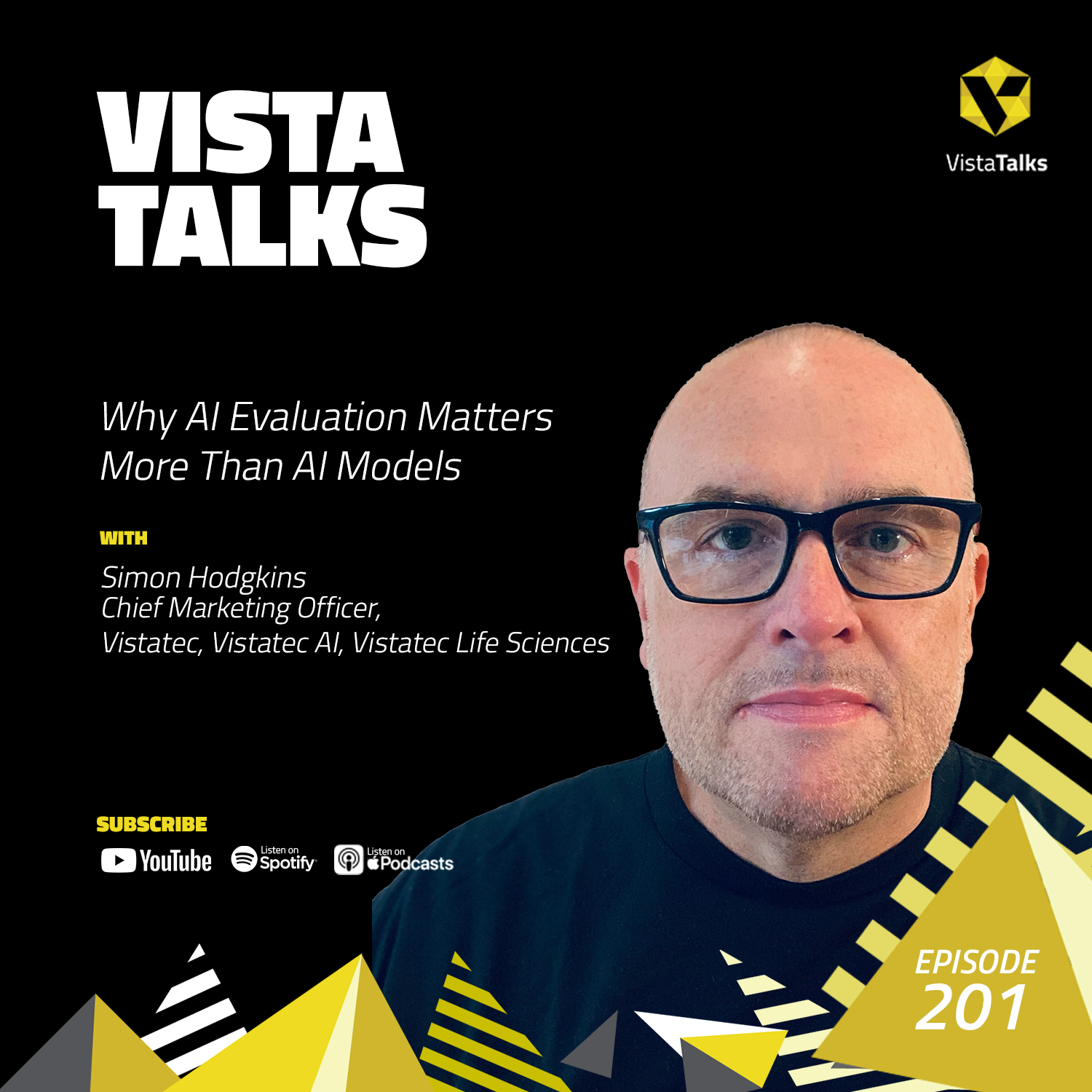
Why AI Evaluation Matters More Than AI Models with Simon Hodgkins - VistaTalks Ep 201
Keywords: AI Evaluation, Trusted AI, Enterprise AI, AI Localization, Enterprise Localization, AI Translation, Machine Translation Evaluation, Translation Quality, AI Benchmarking, Vistatec AI, Simon Hodgkins
Run Time: 10:13
Release Date: August 7, 2026
Listen to the audio or watch the video below.
Simon Hodgkins, Chief Marketing Officer at Vistatec and Vistatec AI, explores one of the most important aspects of enterprise AI adoption: evaluation. Rather than focusing on choosing the newest or fastest large language model, Simon explains why organizations must build confidence through rigorous AI evaluation, benchmarking, governance, and human expertise.
Discover how enterprise organizations can measure translation quality, reduce business risk, maintain brand consistency, and deploy AI responsibly across multilingual content at scale.
Whether you're working in localization, AI, enterprise technology, or digital transformation, this episode provides valuable insights into building trusted AI solutions that deliver measurable business value.
Simon Hodgkins, Chief Marketing Officer at Vistatec and Vistatec AI, explores one of the most important yet often overlooked aspects of enterprise AI adoption: evaluation. In this solo episode of VistaTalks, Simon explains why selecting the latest large language model isn't the real challenge. Instead, success depends on proving that AI-generated translations can consistently meet quality expectations, regulatory requirements, and customer trust.
As organizations rapidly embrace AI-powered localization, this episode provides a practical framework for evaluating AI responsibly, balancing automation with human expertise, and building governance processes that scale with confidence.
Why AI Evaluation Matters
Conversations around artificial intelligence often focus on which model is newest, fastest, or most capable. While those discussions are important, Simon argues that enterprise organizations ask a very different question:
Can we trust the output?
For companies producing multilingual content across dozens of languages, trust is built through evidence rather than assumptions. AI evaluation provides that evidence by measuring quality, consistency, terminology accuracy, brand voice, and regulatory compliance before content reaches customers.
Rather than searching for a universally "best" AI model, organizations should identify the solution that best aligns with their specific business objectives and content requirements.
Every Business Has Different Requirements
One of the episode's key messages is that no two organizations have identical localization needs.
A pharmaceutical company has very different quality standards from those of a software developer. Marketing campaigns require different linguistic approaches than legal documentation. Luxury brands communicate differently than manufacturers.
Because every organization operates with unique terminology, audiences, and compliance requirements, evaluation must be tailored to each business rather than relying on generic benchmarks.
Combining Automation with Human Expertise
Simon explains that effective AI evaluation cannot rely on a single quality score.
Instead, Vistatec combines multiple evaluation methods, including:
Automated quality metrics
Structured linguistic review
Human expert assessment
Business-specific quality criteria
Automated systems provide consistency and scalability, while experienced linguists contribute contextual understanding, cultural awareness, terminology expertise, and professional judgment.
This balanced approach reduces business risk while ensuring translations remain both accurate and natural.
Enterprise AI Requires Enterprise Evaluation
AI-generated translations can appear fluent while introducing subtle but significant issues.
A sentence may read naturally, yet:
Alter approved terminology
Change regulatory language
Weaken brand consistency
Shift intended meaning
These hidden risks reinforce why evaluation must become an integral part of enterprise AI deployment rather than an afterthought.
Benchmarking AI Before Production
Another important topic is benchmarking.
Before deploying AI across thousands or even millions of translated words, organizations need objective comparisons between models, workflows, prompts, and language pairs.
Simon explains that benchmarking enables companies to answer practical operational questions, including:
Which model performs best for our content?
Does prompt engineering improve quality?
Which workflow delivers the greatest consistency?
How does quality vary across languages?
These insights enable informed deployment decisions backed by measurable evidence.
Evaluation as Part of Responsible AI
Evaluation is only one component of a broader AI ecosystem.
Simon discusses how organizations also need:
AI governance
Workflow design
Prompt optimization
Large language model management
Responsible AI adoption
Together, these capabilities create a sustainable AI strategy that evolves alongside rapidly changing technology.
Introducing VistatecVerifier
The episode also highlights VistatecVerifier, Vistatec's proprietary AI-powered quality assurance application.
Rather than replacing human reviewers, Verifier serves as an additional quality control layer by identifying potential issues involving:
Terminology
Grammar
Spelling
Modality
Other linguistic characteristics
This enables localization specialists to focus their expertise where it adds the greatest value.
Human Expertise Remains Essential
One of the strongest themes throughout the discussion is that AI should enhance, not replace, human professionals.
While AI provides remarkable speed and scalability, people remain responsible for:
Judgment
Oversight
Accountability
Decision-making
Simon emphasizes that trusted AI combines technological innovation with experienced human reviewers who ensure quality throughout the localization process.
Looking Ahead
As AI capabilities continue evolving, the organizations that succeed will not necessarily be those using the newest models.
Instead, success is rigorously measuring performance objectively and deploying it responsibly.
The future of enterprise localization depends not simply on faster technology, but on building confidence through evidence, governance, and expert oversight.
Ultimately, trusted AI is built on trust in the evaluation process itself.
Why AI Evaluation Matters More Than AI Models with Simon Hodgkins - VistaTalks Ep 201
Simon Hodgkins, Chief Marketing Officer at Vistatec and Vistatec AI, explores one of the most important aspects of enterprise AI adoption: evaluation. Rather than focusing on choosing the newest or fastest large language model, Simon explains why organizations must build confidence through rigorous AI evaluation, benchmarking, governance, and human expertise.
Discover how enterprise organizations can measure translation quality, reduce business risk, maintain brand consistency, and deploy AI responsibly across multilingual content at scale.
Whether you're working in localization, AI, enterprise technology, or digital transformation, this episode provides valuable insights into building trusted AI solutions that deliver measurable business value.