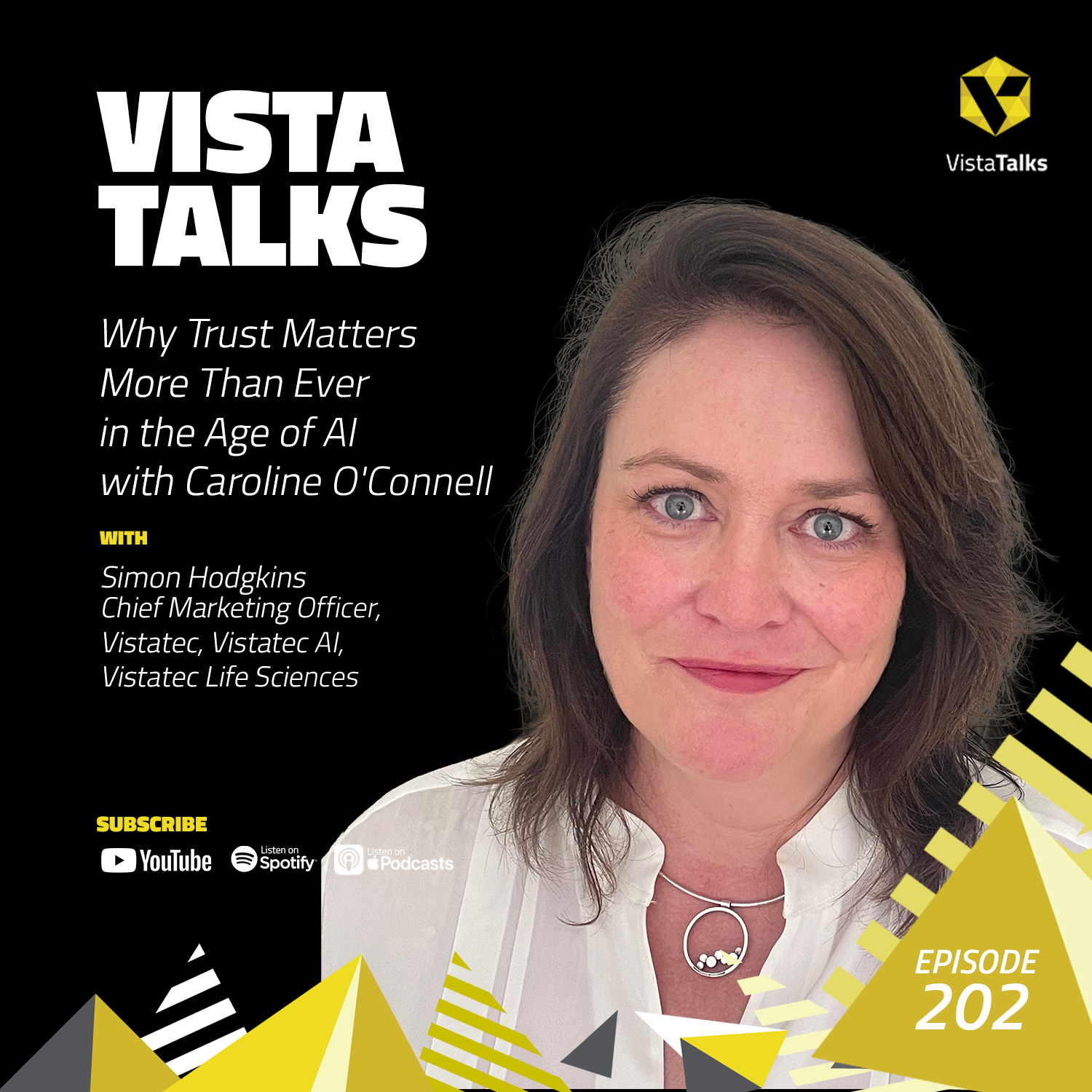
Why Trust Matters More Than Ever in the Age of AI with Caroline O'Connell - VistaTalks Ep 202
Keywords: Responsible AI in localization, Caroline O'Connell, Vistatec, AI Governance, Global Content, Localization Strategy, AI Compliance, Translation, Localization
Run Time:
Release Date: August 19, 2026
Listen to the audio or watch the video below.
Caroline O'Connell, Chief Revenue Officer at Vistatec, joins Host Simon Hodgkins for an insightful conversation about responsible AI, enterprise localization, global content, and the growing importance of trust, transparency, and governance.
Just over a year into her role at Vistatec, Caroline reflects on the rapid changes reshaping the localization industry. She explains why enterprise buyers are moving beyond conversations about cost and turnaround times. Today, organizations are increasingly focused on AI governance, security, compliance, workflow transparency, scalability, and risk.
The discussion explores why AI alone does not guarantee quality or accountability, why human expertise remains essential, and how Vistatec combines technology-led delivery with linguists, domain experts, quality controls, and transparent processes.
Caroline O’Connell, Chief Revenue Officer at Vistatec, joins Host Simon Hodgkins for a timely conversation about the changing localization industry, responsible AI, enterprise content, and the growing importance of trust, transparency, and governance.
Now over a year into her role at Vistatec, Caroline reflects on a period of significant change for both the company and the wider localization sector. From increasingly sophisticated enterprise buyers to the rapid evolution of AI, the conversation explores why localization is moving beyond a traditional service model and becoming a strategic capability directly connected to revenue, customer experience, compliance, and risk.
A Year of Change and Growing AI Maturity
For Caroline, one of the most notable developments of the past year has not simply been the speed of AI adoption, but the growing maturity surrounding it.
Enterprise customers are asking more sophisticated questions. Rather than viewing localization purely through the lens of cost and turnaround times, organizations increasingly want to understand how localization supports revenue, customer experience, security, compliance, and risk mitigation. AI is also moving beyond individual point solutions. Caroline sees it reshaping operating models across the localization industry, affecting providers, competitors, and buyers alike.
The question is no longer simply how quickly content can be delivered. Organizations increasingly need to know whether AI-enabled processes can operate safely, transparently, and at global scale.
Vistatec’s Momentum and Enterprise Focus
The conversation also reflects on Vistatec’s momentum, including its global headquarters in Dublin, growing AI services, investment in technology, and industry recognition.
Caroline describes a company with increasing clarity around where it creates the most value: supporting enterprise clients with complex content and high-stakes requirements.
Much of that confidence comes from Vistatec’s operating model and its ability to combine innovation with established localization expertise. Caroline also highlights the work of the company’s AI division and the importance of continued investment in people, technology, and client partnerships. Rather than simply responding to changes in the industry, the ambition is to help shape where localization goes next.
Enterprise Buyers Are Evaluating Risk, Not Just Cost
One of the most important shifts Caroline identifies is how enterprise organizations evaluate localization partners. Cost and turnaround time remain relevant, but today’s conversations increasingly involve AI governance, data security, workflow resilience, auditability, transparency, and human oversight.
Customers want to know how their content is being handled. They need visibility into how AI is being used and the ability to understand and audit decisions. They also want clarity about where humans remain involved. This has changed the nature of localization relationships.
For Caroline, successful enterprise relationships are increasingly long-term strategic partnerships built around trust and alignment rather than transactional engagements. That trust becomes particularly important as AI introduces new opportunities alongside new questions about responsibility and risk.
Why Human Expertise Still Matters in an AI-Driven World
AI can deliver extraordinary scale and speed, but Caroline makes an important distinction: AI alone does not guarantee quality or accountability. That becomes especially important for organizations operating in regulated or high-risk environments. An inaccurate translation or unchecked AI-generated output could have consequences for compliance, brand trust, and potentially safety.
Vistatec’s approach therefore places AI within a broader framework of verification and human expertise.
AI can provide scale and efficiency, while linguists, domain experts, quality processes, and human oversight help ensure that content remains accurate and appropriate to its context. The result is not a choice between humans and AI. It is about designing systems where technology and expertise work together to create greater confidence.
What Global Enterprise Customers Need
Through her conversations with customers, Caroline identifies three requirements that repeatedly emerge: confidence, scalability, and insight. Organizations need confidence that content is accurate, secure, and compliant. They need the scalability to manage increasing content volumes across multiple markets. And they need better insight into how that content performs, including its quality and associated risks.
Regulation is also becoming a more significant part of these discussions. Caroline points to developments such as the EU AI Act as evidence that organizations need to think carefully about compliance when deploying AI-enabled systems internationally.
For localization providers, this means the role is expanding. It is no longer solely about executing localization tasks. Partners increasingly need to help organizations understand, manage, and optimize global content operations.
Technology Without Losing Transparency
Vistatec has long been known for its technology-agnostic approach, but Caroline also highlights the company’s internal development capabilities and proprietary technology. This combination enables teams to integrate different technologies while developing solutions around complex customer requirements.
Whatever technology is deployed, however, transparency remains a recurring theme throughout the conversation. Customers need to understand how systems work, how their content is being processed, and where responsibility sits. As AI becomes more deeply embedded in content workflows, transparency becomes fundamental to maintaining trust.
Culture Becomes Visible When Things Get Difficult
Culture can be difficult to quantify, but Caroline offers a straightforward way of thinking about it: culture becomes tangible when things get difficult. When projects are complex, urgent, or high stakes, Vistatec’s teams are expected to work collaboratively rather than in silos. Caroline highlights a strong sense of ownership, problem-solving, and closeness to customers.
She also points to the trusted-advisor relationship Vistatec has developed with many clients. Customers don’t simply ask the company to execute projects; they seek its expertise, guidance, and perspective.
That combination of ownership, collaboration, and commitment to quality helps explain why many client relationships have endured for years.
30 Years of Reinvention and Resilience
With Vistatec approaching its 30th anniversary at the time of recording, Simon and Caroline discuss what longevity means in an industry characterized by continuous technological change. For Caroline, longevity is not accidental. It requires organizations to keep reinventing themselves without losing sight of the principles that made them successful.
Over three decades, localization has experienced multiple waves of technological and market change. Vistatec’s ability to evolve while maintaining its focus on quality, trust, and partnership has been central to that journey. Caroline also highlights agility as an important advantage. The ability to invest, experiment, adapt to changing customer requirements, and move quickly has become increasingly valuable as AI accelerates the pace of change.
Moving the AI Conversation Toward Responsibility
Looking ahead, Caroline believes the localization industry needs to move beyond excitement about what AI can do and have deeper conversations about how to use it. AI governance and accountability will be central to those discussions. Who is ultimately responsible for AI-generated output? What does quality mean in an AI-driven environment? How should standards evolve?
The definition of global content is also becoming more complex.
It is no longer simply about language. Organizations must consider context, culture, channel, risk, and the sustainability of increasingly large content operations.
For Caroline, the future of multilingual communication therefore isn’t only a technology question. It is about building systems that are transparent, reliable, scalable, and designed around the needs of both businesses and end users.
Technology will continue to change rapidly. The principles of trust, quality, accountability, and responsible innovation are likely to become even more important as it does.
Why Trust Matters More Than Ever in the Age of AI with Caroline O'Connell - VistaTalks Ep 202
Caroline O'Connell, Chief Revenue Officer at Vistatec, joins Host Simon Hodgkins for an insightful conversation about responsible AI, enterprise localization, global content, and the growing importance of trust, transparency, and governance.
Just over a year into her role at Vistatec, Caroline reflects on the rapid changes reshaping the localization industry. She explains why enterprise buyers are moving beyond conversations about cost and turnaround times. Today, organizations are increasingly focused on AI governance, security, compliance, workflow transparency, scalability, and risk.
The discussion explores why AI alone does not guarantee quality or accountability, why human expertise remains essential, and how Vistatec combines technology-led delivery with linguists, domain experts, quality controls, and transparent processes.