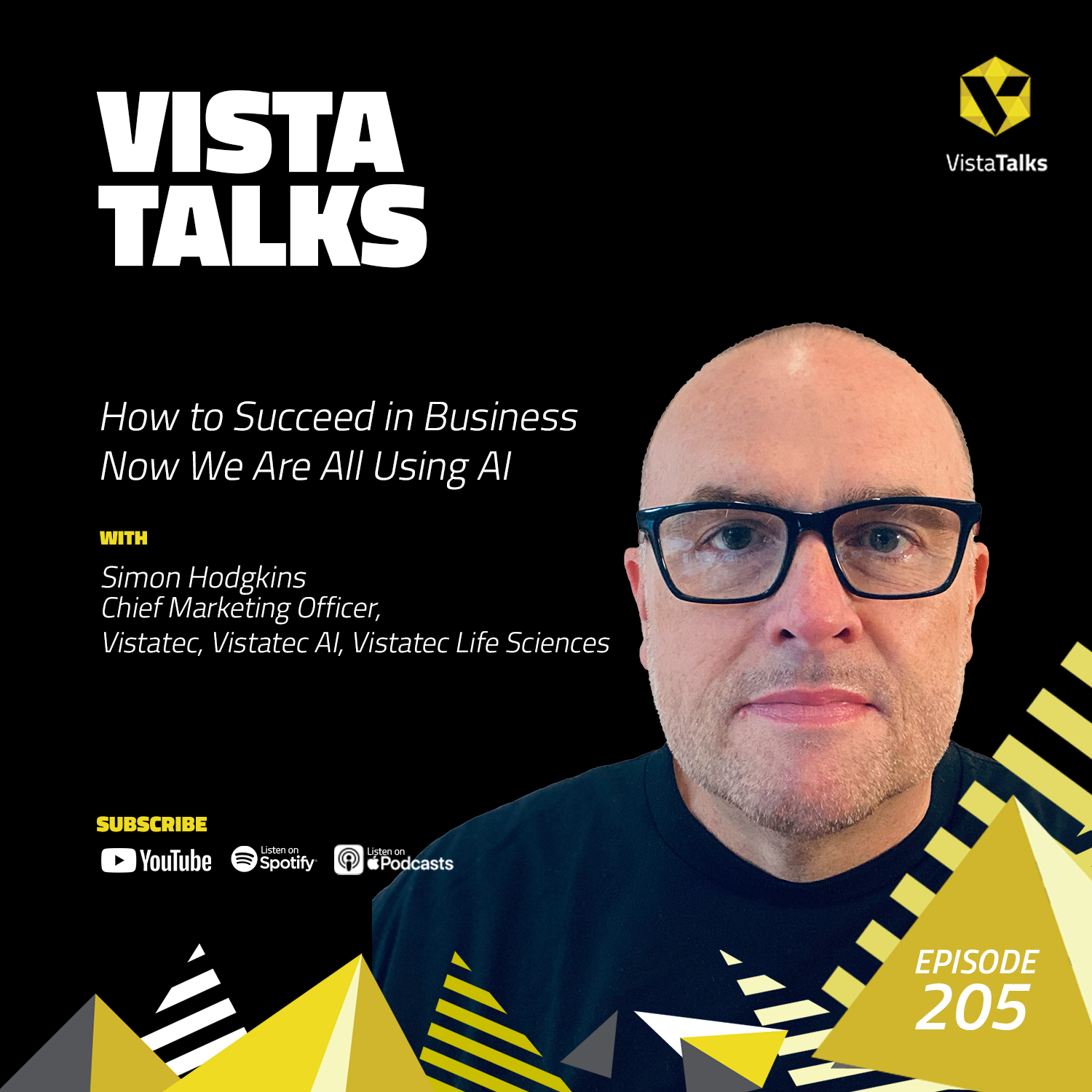
How to Succeed in Business Now We Are All Using AI – VistaTalks Ep 205
Keywords: AI, Localization, Global Business, Artificial Intelligence, Global Marketing, Translation, Multilingual
Run Time: 22:11
Release Date: September 30, 2026
Listen to the audio or watch the video below.
Using recent developments from Google and the wider technology landscape as a starting point, Simon examines what this shift means for global businesses operating across countries, languages, and cultures. From multilingual communication and localization to content creation, customer experience, governance, and human judgment, this episode looks beyond the AI hype to focus on where the technology can create meaningful business value.
Simon Hodgkins, Host of VistaTalks, explores how artificial intelligence is moving beyond standalone tools and becoming embedded in the technologies, customer experiences, and business processes people use every day.
Using recent developments from Google and the wider technology landscape as a starting point, Simon examines what this shift means for global businesses operating across countries, languages, and cultures. From multilingual communication and localization to content creation, customer experience, governance, and human judgment, this episode looks beyond the AI hype to focus on where the technology can create meaningful business value.
Simon Hodgkins, Host of VistaTalks, explores how artificial intelligence is moving beyond standalone tools and becoming embedded in the technologies, customer experiences, and business processes people use every day.
AI Is Becoming Part of Everyday Business
Companies have approached AI adoption as a deliberate transformation initiative, creating working groups, running pilots, assessing platforms, developing governance frameworks, and encouraging employees to experiment with generative AI.
AI is increasingly becoming embedded in the products and services people already use. Search, smartphones, translation, communication tools, cameras, content creation platforms, and productivity applications are gaining AI capabilities without requiring users to make a conscious decision to “use AI.”
As people become accustomed to technology that understands natural language, interprets images, translates conversations, generates content, and responds contextually, they begin expecting similar levels of convenience from the businesses they interact with. A customer who can communicate naturally with the technology in their pocket is unlikely to remain patient with a brand experience that forces them through multiple menus to find an answer.
AI Is Changing the Customer Journey
Traditional digital customer journeys have often followed a predictable path: search for a product, visit a website, read reviews, watch videos, compare alternatives, and perhaps contact sales or customer service before deciding.
Generative AI alters this sequence. Instead of requiring customers to locate, interpret, and assemble information themselves, AI systems can increasingly organize information around the customer's question.
This creates practical implications for marketing and customer experience teams.
Product information must be structured clearly enough for machines as well as humans to understand. Brand content needs to perform in conversational discovery environments as well as conventional search. Customer service teams may encounter customers who arrive better informed and with higher expectations. Perhaps most significantly, content may increasingly be consumed through AI-mediated experiences rather than directly through a company's website.
Traditional digital channels are unlikely to disappear, but the routes customers take through them are becoming considerably less predictable.
Global Business Becomes More Naturally Multilingual
One of the most significant opportunities Simon identifies is the continuing improvement of AI-powered language technology. Real-time translation has existed for years, but advances in language models, voice technology, and contextual understanding are making multilingual interactions increasingly natural.
For international organizations, the implications are considerable. Sales conversations can become easier across languages. Customer support expertise could potentially be allocated based on knowledge rather than language availability. Meetings involving multinational teams could become more accessible, while research, training materials, product documentation, and internal communications could reach employees who previously faced language barriers.
AI can therefore help reduce some of the everyday friction that slows international business. But translation is only part of the equation.
Better Translation Makes Localization More Important
A sentence can be perfectly translated and still feel completely wrong to someone in the target market. Terminology can be technically accurate but unfamiliar. Humor may not travel. Images can carry unintended cultural associations. A call to action that performs well in one country may feel overly aggressive or inappropriate somewhere else.
Language carries culture, context, and expectation.
As AI dramatically increases the amount of multilingual content organizations can produce, human localization expertise could become more valuable rather than less.
Producing words is becoming easier. Determining whether those words are appropriate remains a business and cultural judgment.
This creates an important opportunity for localization professionals. Rather than viewing AI simply as technology that can automate translation, organizations can use it to increase multilingual capacity while relying on human expertise to protect relevance, quality, and cultural appropriateness.
Moving Localization Earlier in the Creative Process
Traditionally, localization has often appeared near the end of the content production workflow. A central marketing team develops a campaign, secures approval, produces master assets, and then asks how many languages are required. By that stage, many of the decisions affecting international performance have already been made.
Simon argues that AI creates an opportunity to move localization and local market intelligence much earlier in the process. Campaign concepts could be evaluated across languages and cultural contexts before production begins. Local terminology, search behavior, regulatory requirements, and market-specific customer questions could influence the original creative brief rather than becoming adaptations after the campaign has already been developed.
The result is not necessarily a collection of disconnected local campaigns. A global campaign can still retain a common idea and brand identity while incorporating market intelligence from the beginning.
Localization Data Can Become Market Intelligence
Localization teams also possess something global organizations can easily underestimate: an enormous amount of information about customers. Every adaptation request potentially contains a signal.
If a particular phrase repeatedly requires modification in Japan, there may be something worth investigating. If customers in Germany consistently use different terminology from the global marketing team, that is useful market information. If a campaign requires extensive adaptation in Brazil but almost none elsewhere, the reasons behind that difference could provide valuable insights.
AI makes it increasingly possible to analyze patterns across large volumes of localized content. This could help localization evolve beyond its traditional position as a production service and become a valuable source of market intelligence for global organizations.
More Content Does Not Automatically Mean Better Marketing
Generative AI makes content faster and cheaper to produce, but that introduces another problem. Customers are not necessarily asking brands to produce hundreds more pieces of content. They want useful information, relevant communication, and experiences that respect their time.
The business case for generative AI therefore cannot depend solely on output. For marketing organizations, the bigger opportunity is using AI to improve relevance without sacrificing quality. AI can help transform campaign assets into different formats, translate and adapt copy, modify imagery, produce localized video variations, reformat product information for different channels, and accelerate the creation of first drafts for local teams to review.
Across 40 or 50 markets, even relatively modest efficiency gains can become significant. But the objective should not simply be to produce more.
AI Governance Is Becoming Brand Governance
As AI makes convincing text, imagery, audio, and video easier to generate, questions about provenance, approval, copyright, privacy, disclosure, and authenticity become increasingly important. Marketing teams need to understand which tools created an asset, what source material was involved, whether appropriate permissions exist, and who remains accountable for approving the final result.
For international organizations, those questions become even more complicated because regulatory expectations differ between markets. The issue becomes particularly important when AI involves a person's image or voice.
Customers do not care which internal department or technology platform generated an inappropriate image or inaccurate claim. They see the brand attached to it. That means AI governance and brand governance are becoming increasingly connected.
Human Judgment Remains Essential
More capable AI does not eliminate the need for people. It changes where human expertise delivers the greatest value. People may spend less time manually producing every individual content variation and more time establishing direction, reviewing quality, interpreting context, understanding markets, and deciding what should ultimately reach customers. That is particularly important in global communication, where linguistic accuracy is only one measure of success.
Context, culture, relevance, appropriateness, and trust still require judgment.
AI can accelerate production and remove friction, but human expertise determines whether the resulting experience actually works.
From "AI Adoption" to Ordinary Infrastructure
One of the episode's most interesting ideas is that the phrase “AI adoption” may eventually become less useful. Businesses rarely debate whether they have adopted the internet or whether employees should use mobile technology. Those technologies became part of normal business infrastructure.
AI is moving in a similar direction.
The transition is more complicated because of questions surrounding intellectual property, privacy, trust, data, governance, and human judgment. But many of the most valuable applications may ultimately appear relatively ordinary. Helping colleagues communicate across languages, making organizational knowledge easier to access, adapting content more intelligently, responding to customers faster, and allowing local market knowledge to influence global decisions.
Global Businesses Priorities
For organizations considering what comes next, the episode highlights several important priorities:
Prepare for AI to become embedded in everyday customer experiences rather than remaining a standalone destination.
Structure brand and product information for conversational and AI-mediated discovery as well as conventional search.
Use advances in AI translation to reduce communication barriers while retaining human localization expertise.
Move localization and market intelligence earlier into campaign planning and creative development.
Treat localization data as a potential source of customer and market intelligence.
Measure generative AI by relevance and quality, not simply by how much content it can produce.
Connect AI governance with existing brand governance, approval, privacy, copyright, and compliance processes.
Use human expertise where it matters most: direction, context, quality, cultural judgment, and final decision-making.
The direction of travel is becoming clearer. AI is moving from something businesses consciously choose to use toward a capability embedded throughout everyday technology. For global organizations, the opportunity is not simply to ask how much more AI can help them produce. The more valuable question is where AI can genuinely improve experiences for customers and employees.
If it enables businesses to understand and communicate with people more naturally, across languages, markets, and cultures, that is progress worth pursuing.
About VistaTalks:
VistaTalks has an incredible lineup of guests from around the globe. We love to feature interesting discussions with interesting people from all around the world. Follow VistaTalks on Spotify for all the latest episodes, or subscribe to the show on Apple and Google Podcasts. VistaTalks is available on many other podcast platforms. To learn more about VistaTalks, please visit https://www.vistatalks.com
How to Succeed in Business Now We Are All Using AI – VistaTalks Ep 205
Using recent developments from Google and the wider technology landscape as a starting point, Simon examines what this shift means for global businesses operating across countries, languages, and cultures. From multilingual communication and localization to content creation, customer experience, governance, and human judgment, this episode looks beyond the AI hype to focus on where the technology can create meaningful business value.
Simon Hodgkins, Host of VistaTalks, explores how artificial intelligence is moving beyond standalone tools and becoming embedded in the technologies, customer experiences, and business processes people use every day.