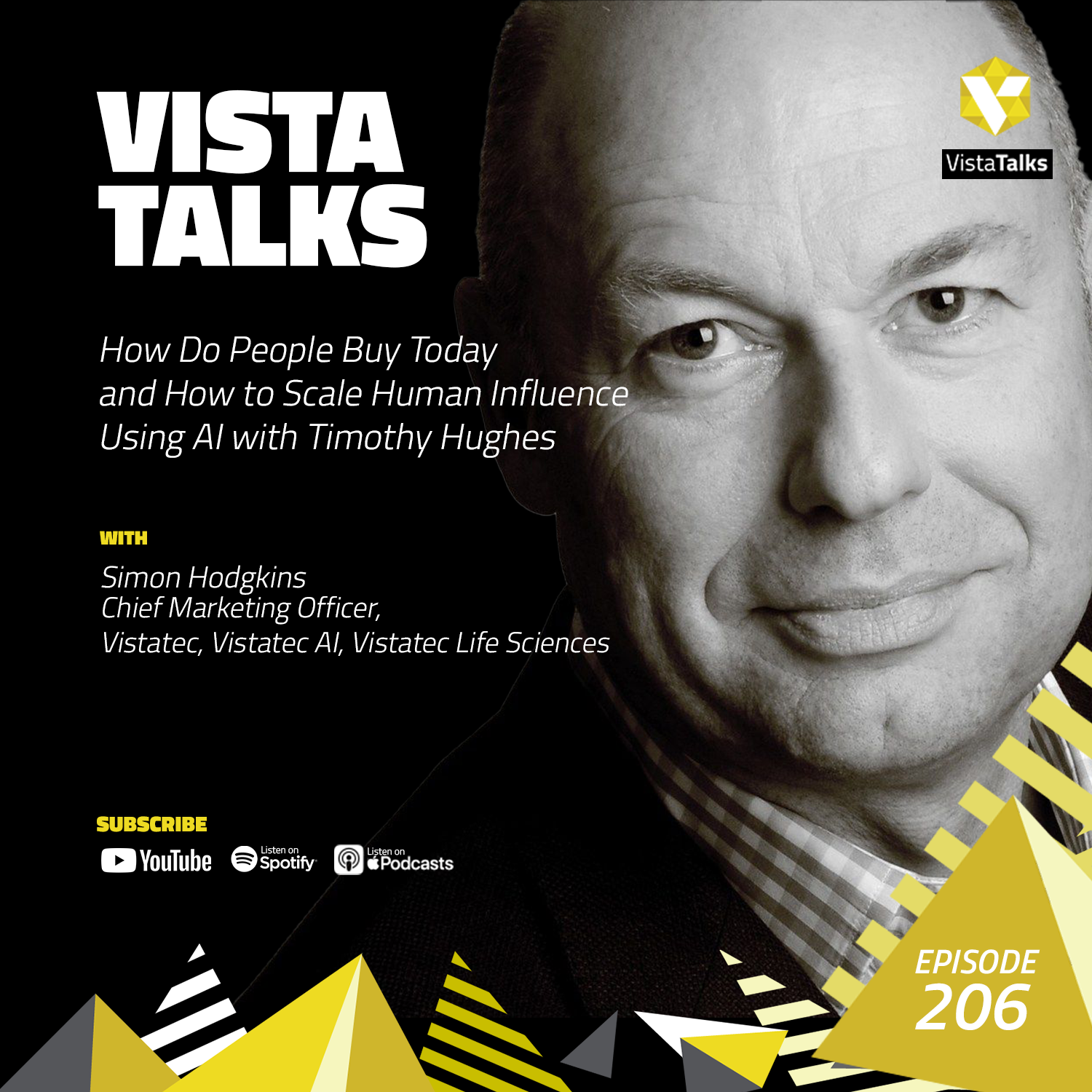
How to Scale Human Influence Using AI with Timothy Hughes – VistaTalks Ep 206
Keywords: Timothy Hughes, Tim Hughes, Azpertilo, Social Selling, LinkedIn, AI Content Creation, Employee Advocacy, AI Agents, VistaTalks Podcast, Simon Hodgkins
Run Time: 27:16
Release Date: October 14, 2026
Listen to the audio or watch the video below.
Timothy “Tim” Hughes, CEO and Co-Founder of Azpertilo, joins Host Simon Hodgkins for a timely conversation about social selling, AI-powered content, authentic human connection, and how people buy today.
In this episode, Tim explains why Azpertilo was built around how people actually buy rather than simply using AI to generate more outreach. The conversation explores authentic AI content, multilingual engagement, brand governance, LinkedIn, AI search visibility, and why human influence may become even more valuable as content creation becomes increasingly effortless.
A recognized authority on social selling, content, and engagement, Tim has written multiple books on the subjects and spent years helping organizations understand how digital relationships influence modern revenue growth.
Timothy “Tim” Hughes, CEO and Co-Founder of Azpertilo, joins Host Simon Hodgkins for a timely conversation about social selling, AI-powered content, authentic human connection, and how people buy today.
In this episode, Tim explains why Azpertilo was built around how people actually buy rather than simply using AI to generate more outreach. The conversation explores authentic AI content, multilingual engagement, brand governance, LinkedIn, AI search visibility, and why human influence may become even more valuable as content creation becomes increasingly effortless.
A recognized authority on social selling, content, and engagement, Tim has written multiple books on the subjects and spent years helping organizations understand how digital relationships influence modern revenue growth.
Building AI Around How People Buy
When Tim and his co-founders began exploring AI, they saw a market filled with tools designed to accelerate familiar sales tactics, including automated calls and email outreach. Instead of following the same path, they started with a different question: How do people buy?
For Tim, the answer comes back to relationships and trust.
That thinking became central to Azpertilo. Rather than using AI to increase outbound activity, the platform helps people build visibility, influence, conversations, and trusted relationships through social channels.
Tim also highlights a persistent challenge he has seen while training thousands of people in social selling. Some immediately understand how to build their online presence, but many hesitate because they don't know what to say, worry about how others will perceive them, or don't have enough time.
Azpertilo aims to reduce those barriers by giving people an AI-powered “teammate” that makes social participation easier.
Moving Beyond Generic AI Content
One of the biggest challenges surrounding generative AI is sameness. If everyone uses similar models and similar prompts, content can quickly begin to sound indistinguishable. Tim and the team approach the problem by grounding AI in company-specific information. Organizations can provide value propositions, ideal customer profiles, case studies, keywords, brand guidelines, and other relevant information.
The platform then goes further by learning each employee’s voice.
As Tim explains, Simon and Tim naturally communicate differently, so their AI-generated content should reflect those differences too. The goal is to combine corporate knowledge and governance with the authentic voice of the person publishing the content. This creates an intriguing opportunity for employee advocacy. Instead of asking employees to distribute identical corporate messaging repeatedly, organizations can communicate consistent ideas through the distinct voices of individual employees.
Scaling Authenticity Across Languages and Markets
For global businesses, authenticity becomes more complicated when content crosses languages, cultures, and markets. Tim explains that Azpertilo has been developed across five languages, with multilingual functionality incorporated into the platform. It can also support activities such as generating comments for LinkedIn conversations.
Tim describes using AI-generated comment suggestions to join discussions and then turn those interactions into new connections and, potentially, sales conversations. It is a practical example of AI supporting human interaction rather than replacing the relationship entirely.
Brand Governance and Keeping AI on Track
Giving employees AI tools introduces another challenge: governance. Organizations need content to stay aligned with brand requirements, especially when dozens, hundreds, or thousands of people could use the technology.
Tim explains that grounding the AI in brand guidelines was not enough on its own. Azpertilo therefore includes additional checking capabilities that can be configured as recommendations or mandatory requirements. Those controls can address areas such as profanity, product references, future commitments, competitor mentions, and other topics an organization wants employees to avoid.
The team also continuously monitors the platform for model and output changes. Tim describes this as constantly “tuning” the system, refining elements such as ideal customer profiles and value propositions while watching for unwanted drift.
Giving Every Employee a Digital Territory
Personalization goes beyond writing style. Tim explains that individual users can have their own “digital territory,” allowing salespeople to focus on specific accounts, industries, keywords, customer profiles, or value propositions. That becomes particularly important in complex B2B environments. A salesperson targeting financial services will have very different priorities from someone working with life sciences, even if both work for the same company.
Tim gives the example of an early Azpertilo customer, a French agri-tech company with numerous ideal customer profiles across its supply chain. The platform is intended to accommodate that complexity rather than force every salesperson into an identical approach.
From SEO to AI Visibility
The conversation also turns to one of the biggest changes affecting digital marketing: how brands get discovered in an AI-driven world. Traditional search engine optimization has long focused on helping content appear prominently in search engines. But as people increasingly seek information through AI systems, businesses also need to consider whether their expertise and content are visible within that ecosystem.
Tim argues that brands need a deliberate approach to being discoverable and cited by AI systems, and he sees LinkedIn as an important part of that strategy for B2B organizations.
For businesses, that creates another reason to publish genuinely useful, insightful content rather than simply increasing content volume.
Connecting Social Activity to Business Results
One persistent difficulty with social selling is proving its commercial impact. Tim discusses Azpertilo’s ability to bring LinkedIn performance data into dashboards, helping organizations understand metrics such as network growth, impressions, content activity, ICPs, and value propositions.
He also outlines the vision in which social activity can connect with CRM infrastructure through technologies such as MCP servers. The aim is to create a clearer journey from an individual post and its impressions through to meetings and ultimately revenue.
Using AI to Scale Humanity
Perhaps the most interesting part of the conversation comes when Simon asks whether the human voice will become more valuable as AI-generated content becomes ubiquitous. Tim believes human behavior remains fundamental. The amount of content someone can consume does not suddenly expand because AI can produce hundreds of additional articles. People still have limited attention, and they continue to gravitate toward individuals they know, like, trust, and find interesting.
That means creating more content is not necessarily the answer.
Instead, Tim sees an opportunity to use AI to help employees create visibility and influence while retaining the characteristics that make human communication meaningful. As he puts it, the opportunity is to use AI to “scale their humanity” rather than merely scaling the production of generic AI content.
The Future of Social Selling Is Human and AI-Powered
This VistaTalks conversation highlights an important shift in the AI discussion, making sure that content sounds authentic, reflects the organization behind it, reaches the right people, supports genuine conversations, and ultimately contributes to trusted relationships.
For Tim Hughes, AI and social selling do not need to sit on opposite sides of that equation. Used thoughtfully, AI can make it easier for more employees to participate in social conversations while maintaining their individual voices.
As AI makes content production faster and easier, authentic human influence may become one of the most important differentiators businesses have.
How to Scale Human Influence Using AI with Timothy Hughes – VistaTalks Ep 206
Timothy “Tim” Hughes, CEO and Co-Founder of Azpertilo, joins Host Simon Hodgkins for a timely conversation about social selling, AI-powered content, authentic human connection, and how people buy today.
In this episode, Tim explains why Azpertilo was built around how people actually buy rather than simply using AI to generate more outreach. The conversation explores authentic AI content, multilingual engagement, brand governance, LinkedIn, AI search visibility, and why human influence may become even more valuable as content creation becomes increasingly effortless.
A recognized authority on social selling, content, and engagement, Tim has written multiple books on the subjects and spent years helping organizations understand how digital relationships influence modern revenue growth.