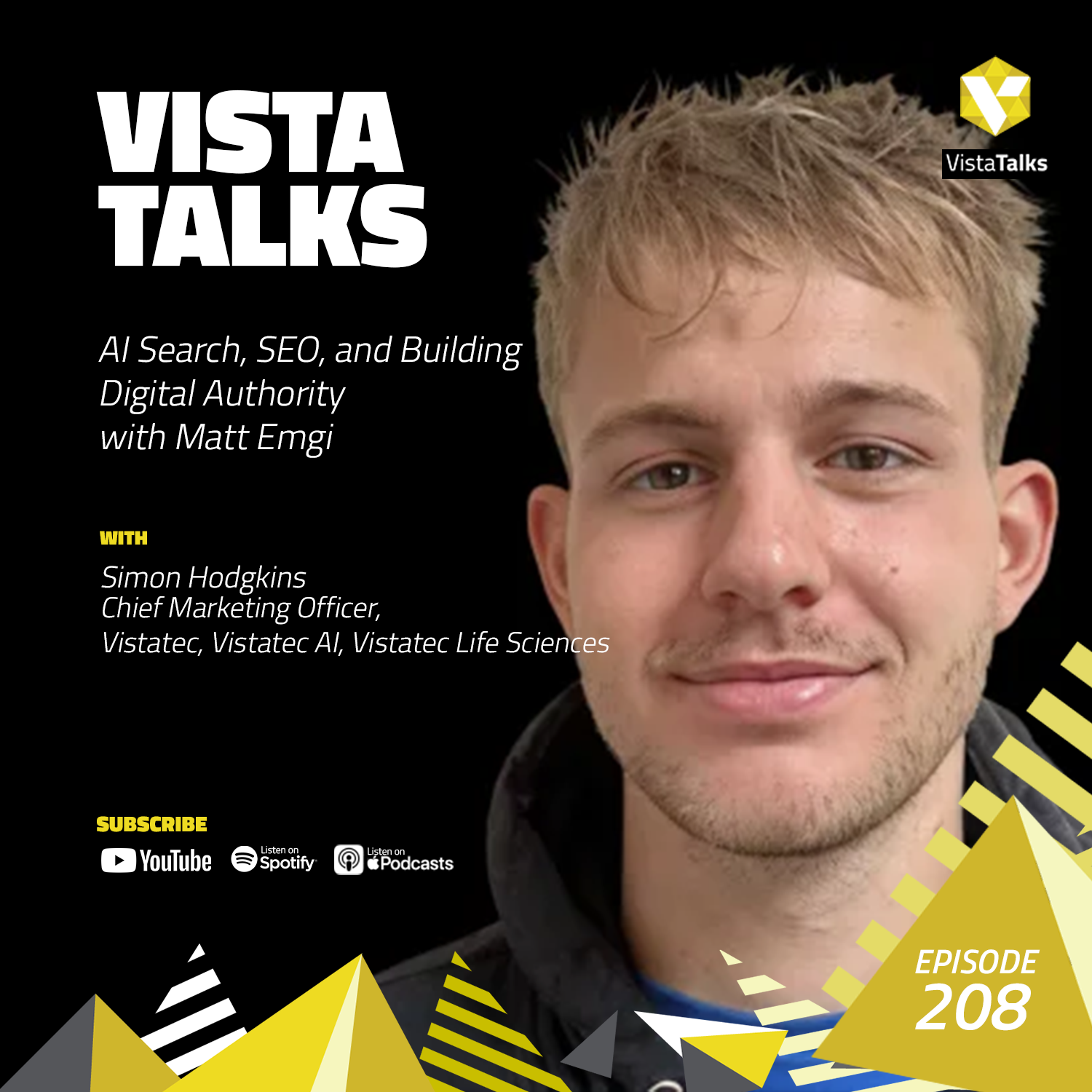
AI Search, SEO, and Building Digital Authority with Matt Emgi - VistaTalks Ep 208
Keywords: GEO, SEO, AI Search, Localization, Brand, Trust, AI
Run Time: 20:34
Release Date: November 11, 2026
Listen to the audio or watch the video below.
Matt Emgi, Founder of Emgi Group, joins Host Simon Hodgkins for an insightful conversation about the changing world of generative engine optimization (GEO), search engine optimization (SEO), and building digital authority in an increasingly AI-driven marketplace.
As artificial intelligence transforms how people discover businesses, evaluate products, and make purchasing decisions, traditional approaches to online visibility are being challenged. Matt shares his journey from affiliate marketing and content creation to helping technology companies strengthen their digital presence, build trust, and convert visibility into meaningful commercial growth.
The conversation explores the rise of zero-click search, the importance of brand authority, international content strategies, the challenges of measuring marketing ROI, and why experimentation and adaptability are becoming essential competitive advantages.
From Affiliate Marketing to Building Digital Authority
Interested in affiliate marketing, Matt started building websites, writing blog content, and learning how to attract organic search traffic.
His early efforts focused on technology-related content, including software recommendations and web hosting comparisons. It was an introduction to the practical realities of SEO and the importance of understanding how people search for information online.
A significant milestone came when Matt contributed content to technology publication VentureBeat. That exposure helped him secure his first client and begin developing his expertise beyond content writing.
As his experience grew, Matt recognized an often-overlooked element of successful SEO: authority.
While traditional SEO discussions frequently centered on keywords, rankings, and backlinks, Matt began focusing on the broader challenge of establishing credibility through authoritative publications, brand mentions, and strategic digital relationships.
This expertise eventually led to the founding of Emgi Group, where Matt works with technology businesses to strengthen their digital authority and improve visibility.
His experience provides a valuable perspective on how search marketing has evolved and why businesses need to reconsider what successful digital growth looks like.
The New Rules of Search
One of the central themes of the discussion is the fundamental shift in how people discover information online.
For years, businesses invested heavily in informational content designed to attract visitors through Google searches. Blog posts answering basic questions could generate significant traffic and introduce potential customers to a brand.
However, AI-powered search experiences are changing that model.
Large language models (LLMs) and AI-generated search summaries increasingly provide direct answers, reducing the need to visit individual websites.
Matt explains that businesses must rethink their priorities.
"No longer is SEO about attracting cheap traffic."
Rather than producing large volumes of generic informational content, companies should focus on appearing when potential customers are actively considering a purchase.
For example, a software company may generate greater commercial value by appearing in searches comparing competing platforms than by ranking for broad educational queries.
This creates a new strategic question for marketers.
It is no longer simply about how much traffic a website attracts. It is about whether the business is visible at the moments that influence revenue.
Matt encourages companies to focus on commercially relevant content, product comparisons, alternatives to established competitors, and the questions potential customers ask before making a purchase.
Generative Engine Optimization and Building a Brand AI Can Recommend
Generative engine optimization, commonly known as GEO, is creating new opportunities and challenges for businesses.
Traditional SEO focuses on improving visibility within search engine results. GEO extends this thinking to AI-powered discovery environments, where users increasingly ask conversational questions and receive synthesized recommendations.
Matt highlights an important distinction: businesses may not always know when an AI-generated recommendation excludes them.
In traditional sales processes, companies often know when they have competed for an opportunity and lost. In AI search, they may never realize that a potential customer considered their category without encountering their brand.
"Being recommended or not being recommended is the difference between a sale or not."
This makes digital authority increasingly important.
Matt describes GEO as having meaningful similarities with SEO, but with a greater emphasis on broader brand-building activities.
He identifies several ways businesses can strengthen their presence:
Secure relevant coverage in authoritative industry publications.
Participate in podcasts and expert interviews.
Publish original research and proprietary data.
Build credible founder-led and employee-led brands.
Develop a presence on YouTube, LinkedIn, and other relevant platforms.
Participate authentically in communities such as Reddit and Quora.
Create content that addresses genuine customer needs and purchasing decisions.
The objective is to establish a recognizable, credible brand across multiple digital environments.
These activities can create additional opportunities for a company to be discovered, referenced, and considered, although no single tactic guarantees inclusion in AI-generated answers.
Why Trust and Brand Authority Matter More Than Ever
Throughout the conversation, Simon and Matt return to one essential concept: trust.
As AI-generated content becomes increasingly common, businesses face the challenge of demonstrating authentic expertise and credibility.
Matt emphasizes that digital authority is not simply about acquiring backlinks or generating mentions. It is about establishing a meaningful presence within the information sources and communities that influence customers.
Industry publications, original research, thought leadership, and credible social engagement all contribute to a stronger digital identity.
Founder-led marketing is particularly interesting in this environment.
When founders and employees share useful insights, join industry conversations, and demonstrate their expertise, they can humanize a business and strengthen its reputation.
Podcasts provide another opportunity to establish authority.
They let business leaders share their knowledge, explain their perspectives, and build relationships with audiences in ways conventional marketing content may struggle to achieve.
The broader lesson is that digital visibility and brand credibility should no longer be treated as entirely separate marketing objectives.
International SEO, Localization, and Cultural Relevance
For companies expanding into international markets, AI-powered search introduces additional considerations.
Simon raises the example of a US-based company looking to expand into Asia and European markets, including Germany and France.
How should a business approach visibility when different audiences use different languages, platforms, and search behaviors?
Matt highlights the importance of localization.
Effective localization involves more than translating existing content. Businesses must ensure that their messaging reflects the language, cultural expectations, and commercial context of the markets they want to reach.
Content that performs well in one country will not necessarily generate the same results elsewhere.
Matt also explains that AI systems may access information through different mechanisms, including retrieval-augmented generation (RAG), which lets models incorporate externally retrieved information and knowledge learned during training.
This creates opportunities for businesses to develop authoritative, relevant content that can be discovered through multiple channels.
While Matt acknowledges that multinational localization isn't his primary area of expertise, his broader recommendation remains consistent: create valuable thought leadership that demonstrates expertise and addresses the intended audience's needs.
For international businesses, this means pairing strong brand authority with genuinely localized content instead of relying on direct translation alone.
Creating Content That Influences Purchasing Decisions
Matt outlines a practical approach to content strategy that reflects how customers move through the buying process.
Rather than treating every search query equally, he recommends understanding the different stages of customer intent.
At the top of the funnel, educational content helps audiences understand problems and possible solutions.
In the middle of the funnel, potential customers begin evaluating different approaches, products, and providers.
At the bottom of the funnel, buyers actively compare options and prepare to make purchasing decisions.
Matt believes businesses should place greater emphasis on content closer to these commercially valuable moments.
For software companies, this might include comparison articles, competitor alternatives, product use cases, and category-specific recommendations.
He gives the example of searches for alternatives to established software platforms such as HubSpot.
These searches can indicate that someone is already considering a change, making them particularly relevant to companies offering competing solutions.
However, Matt also stresses that informational content still matters.
The key is to create content that genuinely helps the reader while clearly showing how the business's products or services solve relevant problems.
A successful content strategy therefore balances education, credibility, and commercial intent.
Measuring Digital Authority and Marketing ROI
One of the most challenging topics in modern digital marketing is attribution.
Businesses want to understand whether their investments in SEO, GEO, and brand authority are generating measurable commercial results.
Yet the customer journey is rarely straightforward.
A potential customer might first discover a business through an AI-generated recommendation, encounter its founder on LinkedIn, visit its website several weeks later, and ultimately convert after clicking a paid advertisement.
Which channel deserves credit?
Matt acknowledges that attribution has always been difficult in SEO and is becoming even more complicated with AI-powered discovery.
He also questions whether tracking brand visibility in AI responses is sufficient to demonstrate business value.
While new tools let companies monitor how often they appear in AI-generated answers, Matt argues that visibility alone isn't the ultimate objective.
"What ultimately matters is the right kind of person coming on to make a purchase decision through you."
He recommends examining actual customer behavior and understanding the journeys that lead to meaningful conversions.
Tools such as Microsoft Clarity and PostHog can help businesses analyze how visitors interact with websites, navigate content, and respond to calls to action.
Companies should also investigate which pages drive demo bookings, inquiries, downloads, and other valuable actions.
For teams under pressure to demonstrate return on investment, the message is clear: connect digital authority to business outcomes wherever possible rather than relying exclusively on visibility metrics.
Cutting Through the AI Hype
With new AI tools, automation platforms, and marketing techniques appearing constantly, businesses face an overwhelming volume of information.
Some innovations offer genuine opportunities. Others attract attention without delivering meaningful commercial improvements.
Simon asks Matt how companies can distinguish valuable developments from industry hype.
Matt suggests that one of the biggest misconceptions concerns AI-powered automation.
Automating a task does not automatically mean it will be completed effectively.
For example, generating a blog post using AI may be relatively straightforward. However, creating a genuinely useful article still requires strategic thinking.
Someone must understand the audience, structure the information, identify credible sources, determine appropriate internal links, and ensure that the content serves a clear business purpose.
Automation can accelerate production, but it does not eliminate the need for judgment.
Matt also questions whether AI has necessarily delivered the productivity improvements many people originally expected.
As technology makes certain tasks easier, organizations can end up creating more work instead of focusing on what genuinely matters.
The challenge is to identify where AI adds value without letting experimentation become a distraction from core business objectives.
Why Speed, Experimentation, and Adaptability Win
As the conversation draws to a close, Matt shares what he considers one of the most important characteristics of successful businesses today.
It is not necessarily access to the latest technology or the most sophisticated automation system.
It is the willingness to experiment, implement ideas quickly, and adapt when circumstances change.
Matt highlights the value of resourceful founders, marketers, and sales professionals who test new approaches rather than waiting for certainty.
As platforms, algorithms, and customer behaviors continue to evolve, agility can provide a significant advantage.
However, experimentation must remain connected to practical business priorities.
Implementing every new AI tool simply because it is attracting attention offers little value.
Instead, businesses should assess opportunities, test promising approaches, learn from results, and adjust their strategies accordingly.
Matt summarizes the principle by emphasizing "the speed of implementation and that ability to do something quickly."
Simon reinforces the message in his closing remarks: trying new things doesn't mean taking unnecessary risks, but businesses must be prepared to explore new opportunities to stay competitive.
What Businesses Can Learn from Matt Emgi
The conversation offers several practical lessons for organizations navigating the changing digital landscape.
1. Prioritize commercial relevance over traffic volume. Focus on reaching potential customers when they are actively researching solutions and making purchasing decisions.
2. Build authority beyond your own website. Strengthen your presence through credible publications, podcasts, original research, communities, and industry conversations.
3. Adapt SEO strategies for AI-powered discovery. Consider how your brand is represented across the sources that search engines and AI systems may use.
4. Understand your ideal customer. Identify the needs, purchasing behaviors, challenges, and motivations of your most valuable audiences.
5. Localize for international markets. Ensure that content reflects local language, culture, and customer expectations.
6. Measure meaningful business outcomes. Examine customer journeys, conversions, and commercial influence rather than relying exclusively on traffic or visibility metrics.
7. Use AI thoughtfully. Automation should support strategic thinking and improve processes, not replace the judgment required to produce valuable work.
8. Experiment and adapt quickly. Organizations willing to test ideas and respond to change can position themselves more effectively in a rapidly evolving market.
The Future of Search Belongs to Brands That Build Trust
Matt Emgi's conversation with Simon Hodgkins highlights an important evolution in digital marketing.
The fundamentals- helping customers, demonstrating expertise, and building credible brands- remain essential. What is changing is how people discover, evaluate, and consume that information.
As AI-powered search becomes more influential, businesses must think beyond traditional rankings and website traffic.
They need to understand how customers make decisions, where their brands appear in relevant conversations, and whether their digital presence contributes to measurable commercial growth.
The future of search will not be determined by optimization techniques alone.
It will also depend on credibility, relevance, adaptability, and the ability to build meaningful customer connections.
The key takeaway? In an AI-driven world, visibility matters, but trust, consideration, and choice drive business growth.
AI Search, SEO, and Building Digital Authority with Matt Emgi - VistaTalks Ep 208
Matt Emgi, Founder of Emgi Group, joins Host Simon Hodgkins for an insightful conversation about the changing world of generative engine optimization (GEO), search engine optimization (SEO), and building digital authority in an increasingly AI-driven marketplace.
As artificial intelligence transforms how people discover businesses, evaluate products, and make purchasing decisions, traditional approaches to online visibility are being challenged. Matt shares his journey from affiliate marketing and content creation to helping technology companies strengthen their digital presence, build trust, and convert visibility into meaningful commercial growth.
The conversation explores the rise of zero-click search, the importance of brand authority, international content strategies, the challenges of measuring marketing ROI, and why experimentation and adaptability are becoming essential competitive advantages.