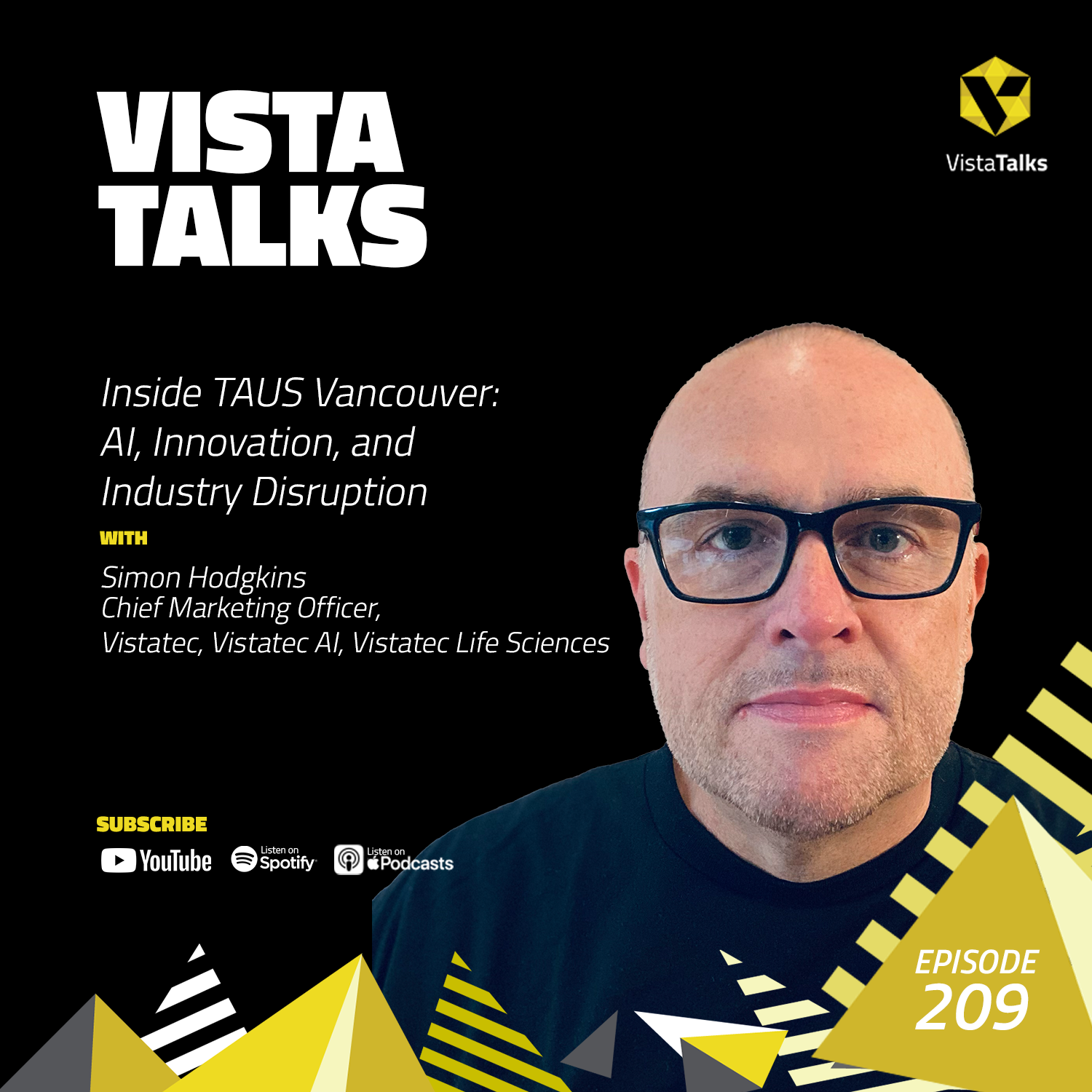
Inside TAUS Vancouver: AI, Innovation, and Industry Disruption with Simon Hodgkins - VistaTalks Ep 209
Keywords: TAUS, Vancouver, AI, Orchestration, Translation, LocalizationTraining Data, AI Translation
Run Time: 6:25
Release Date: November 25, 2026
Listen to the audio or watch the video below.
The localization industry is undergoing a significant transformation as artificial intelligence reshapes how organizations manage multilingual content, evaluate translation quality, and deliver global communications.
In this episode of VistaTalks, Host Simon Hodgkins shares key insights from TAUS Vancouver 2026, where enterprise buyers, researchers, technology leaders, and localization professionals gathered to explore the future of AI-powered language services.
Held from October 14–16 at the Sutton Place Hotel in Vancouver, Canada, the conference explored the theme "The Art of Mastering Intelligence as a Utility."
The three-day event also marked the beginning of Vancouver Localization Week, an extended industry program running through October 21 in conjunction with LocWorld.
With Vistatec represented throughout the week, the event provided an opportunity to connect with localization leaders, discuss emerging challenges, and examine how businesses are adapting their language strategies to an increasingly AI-driven environment.
From AI orchestration and multilingual benchmarking to evolving business models and the future of language service providers, Simon highlights the conversations shaping the next chapter of the localization industry.
AI Orchestration Is Transforming Translation Management
One of the most significant themes emerging from TAUS Vancouver was the evolution of traditional translation management systems (TMS).
For years, TMS platforms have provided the infrastructure for managing translation projects, coordinating linguistic resources, and delivering multilingual content.
However, artificial intelligence is fundamentally changing how these systems operate.
Conference discussions explored how traditional translation management platforms are evolving into sophisticated AI orchestration environments, where intelligent agents automate routine tasks, coordinate workflows, and help organizations determine the most appropriate approach for different types of content.
Rather than relying on a single translation engine or workflow, businesses are increasingly adopting adaptive systems that combine machine translation, large language models, automation, and human linguistic expertise.
Importantly, the conversations reinforced that automation does not eliminate the need for human judgment.
For high-risk, sensitive, or business-critical content, expert linguists remain essential to maintaining quality, accuracy, and reliability.
Simon highlighted how Vistatec approaches this challenge through adaptive AI workflows that route content according to risk, allowing linguistic specialists to focus on the areas where their expertise delivers the greatest value.
The emerging message is clear: the future of localization is not simply about automating translation. It is about intelligently orchestrating people, technology, and processes.
From Product Demonstrations to Practical Innovation
Another standout feature of TAUS Vancouver was its emphasis on collaborative problem-solving.
Rather than focusing exclusively on polished technology demonstrations, the conference introduced hands-on sandbox environments designed to encourage experimentation and practical innovation.
Participants worked together to develop ideas addressing real challenges in AI-powered localization.
These included improvements to human-in-the-loop workflows, API integrations, AI governance, and the guardrails required to deploy language technologies responsibly.
Ideas were discussed and refined in collaborative groups before being presented during a live pitch session.
This approach encouraged attendees to move beyond theoretical discussions and explore how emerging technologies could solve genuine operational challenges. The format reflected an important shift in the industry. Organizations are increasingly interested in solutions that demonstrate measurable value, improve efficiency, and address existing workflow limitations. Innovation is no longer defined solely by introducing new technology. It is increasingly measured by how effectively that technology solves business problems.
Who Really Owns the AI Margin?
One of the more commercially significant discussions at the conference focused on the economics of artificial intelligence. As AI becomes embedded in localization platforms, questions are emerging about pricing structures, transparency, and the distribution of value across the technology ecosystem.
Traditional translation management providers are increasingly introducing proprietary AI processing units, usage credits, and additional charges layered on top of the underlying costs of large language models.
This creates a situation where enterprise customers may effectively pay for multiple layers of technology within a single AI-powered workflow.
The central question raised during the conference was straightforward:
Which layer of the AI technology stack is actually creating value for the customer?
For organizations managing significant volumes of multilingual content, understanding these costs is becoming increasingly important.
Simon discussed the value of transparent LLM management, which enables enterprises to understand model expenditure and select the most appropriate AI engine for each task.
Different content types require different combinations of speed, quality, accuracy, and cost efficiency.
An intelligent orchestration strategy allows organizations to balance these requirements rather than applying the same technology indiscriminately across every workflow.
As AI adoption accelerates, transparency around technology costs and commercial models will become an increasingly important consideration for localization buyers.
Why AI Translation Benchmarks Need a Reality Check
AI benchmarking was another major topic at TAUS Vancouver.
With new language models entering the market and existing technologies evolving rapidly, organizations face growing pressure to identify which systems deliver the strongest performance.
However, researchers from Carnegie Mellon University and CSA Research challenged the assumption that publicly available AI leaderboards necessarily reflect real-world translation performance.
While rankings can provide useful indicators, they do not always capture the linguistic, cultural, and operational complexities encountered in enterprise localization.
This is particularly relevant for regional language variants, including Canadian French, where language preferences, terminology, and cultural expectations can differ significantly from those represented in general-purpose benchmarks.
Conference participants emphasized the importance of evaluating AI systems against practical business requirements. These include translation quality, processing speed, operational cost, and domain-specific accuracy.
A model that performs well on a general benchmark may not necessarily be the best choice for specialized legal, technical, financial, or customer-facing content.
For enterprise buyers, independent quality evaluation is therefore essential.
Rather than relying exclusively on public rankings or vendor claims, organizations need evidence that demonstrates how AI systems perform against their specific content, languages, and business objectives.
The best-performing AI model is not necessarily the highest-ranked model. It is the one that delivers the right results for the task.
The Changing Role of Language Service Providers
The future of language service providers (LSPs) generated considerable discussion throughout the conference.
As artificial intelligence automates increasing portions of traditional translation workflows, language service providers are reassessing how they create value and differentiate their services.
Simon identified three potential directions discussed by industry participants.
The first involves moving further up the value chain, with providers expanding beyond translation delivery into strategic consulting, localization planning, cultural expertise, and broader multilingual content services.
The second focuses on technology orchestration, positioning LSPs as specialists in managing complex AI ecosystems, integrating different models, and designing efficient workflows.
The third centers on becoming the human data layer behind AI.
In this model, language service providers contribute the linguistic expertise, data preparation, annotation, evaluation, and quality assurance needed to improve AI systems.
Each approach reflects a broader transformation in the relationship between language expertise and technology.
For Vistatec, these developments align with its expanding AI services and data capabilities.
As organizations adopt more sophisticated AI systems, the quality and management of the underlying data become increasingly important. Language service providers that successfully combine linguistic expertise, technology integration, and data services may find new opportunities to support enterprise customers.
Human Expertise Remains Essential in an AI-Driven Industry
Despite the strong emphasis on artificial intelligence, one of the recurring messages from TAUS Vancouver was the continued importance of human expertise.
AI agents can automate routine activities, accelerate content processing, and support increasingly sophisticated multilingual workflows.
However, the technology still requires effective oversight, particularly when accuracy, compliance, brand reputation, or cultural sensitivity is at stake.
The challenge for organizations is determining where human involvement creates the greatest value. Applying the same level of review to every piece of content can be inefficient and costly. Equally, removing human oversight from sensitive material can introduce unacceptable risks. Risk-based workflows offer a more balanced approach.
By evaluating content according to its purpose, complexity, sensitivity, and business impact, organizations can determine which tasks are suitable for automation and which require specialist linguistic review.
This approach enables businesses to improve efficiency while protecting the quality and reliability of their global communications.
The future is therefore likely to involve closer collaboration between AI technologies and language professionals rather than a complete replacement of human expertise.
Five Key Takeaways from TAUS Vancouver
Reflecting on the discussions and insights from the event, several important lessons stand out for organizations navigating the changing localization landscape.
1. AI orchestration is becoming a strategic priority.
Organizations need flexible workflows that integrate multiple technologies, automate routine processes, and involve human experts when necessary.
2. Practical innovation matters more than technology demonstrations.
Businesses increasingly want solutions that address genuine operational challenges and deliver measurable improvements.
3. AI cost transparency is essential.
Understanding the economics of AI platforms, processing credits, and underlying language models will help enterprises make more informed technology decisions.
4. Independent benchmarking supports better procurement.
AI systems should be evaluated against real business requirements, including language variants, domain accuracy, latency, and cost.
5. Language service providers must continue evolving.
The next generation of successful LSPs will increasingly combine language expertise with AI orchestration, strategic consulting, and data services.
The Future of AI-Powered Localization
TAUS Vancouver 2026 demonstrated that the localization industry is entering a new phase of technological and commercial transformation.
Artificial intelligence is no longer simply an additional capability within traditional translation workflows. It is becoming a foundational component of how organizations design, manage, and scale multilingual communications. However, successful adoption requires more than access to powerful language models. Businesses must consider orchestration, quality assurance, cost transparency, governance, and the role of human expertise.
The discussions in Vancouver also highlighted the importance of collaboration across the localization ecosystem. Technology providers, language service companies, researchers, and enterprise buyers all have a role in shaping the next generation of multilingual solutions.
For Simon and the Vistatec team, the conference reinforced the importance of developing adaptive AI workflows, investing in data capabilities, and helping organizations make informed decisions about emerging language technologies.
Inside TAUS Vancouver: AI, Innovation, and Industry Disruption with Simon Hodgkins - VistaTalks Ep 209
The localization industry is undergoing a significant transformation as artificial intelligence reshapes how organizations manage multilingual content, evaluate translation quality, and deliver global communications.
In this episode of VistaTalks, Host Simon Hodgkins shares key insights from TAUS Vancouver 2026, where enterprise buyers, researchers, technology leaders, and localization professionals gathered to explore the future of AI-powered language services.
Held from October 14–16 at the Sutton Place Hotel in Vancouver, Canada, the conference explored the theme "The Art of Mastering Intelligence as a Utility."
The three-day event also marked the beginning of Vancouver Localization Week, an extended industry program running through October 21 in conjunction with LocWorld.
With Vistatec represented throughout the week, the event provided an opportunity to connect with localization leaders, discuss emerging challenges, and examine how businesses are adapting their language strategies to an increasingly AI-driven environment.
From AI orchestration and multilingual benchmarking to evolving business models and the future of language service providers, Simon highlights the conversations shaping the next chapter of the localization industry.